The program structure

Workshops built around your actual work

Sessions are focused, practical, and grounded in the specific situations you face in your role. You practise with real projects and real relationships, not invented scenarios.

How the sessions work

Structured learning with room for your specific context

Each workshop session combines a short conceptual framework with extended practice time. The frameworks are drawn from communication research and organisational psychology. The practice time is spent on your situations, not textbook examples.

Sessions run in small groups or as individual engagements, depending on your preference and circumstances. Small group sessions include interaction with peers facing similar challenges, which often accelerates learning. Individual sessions allow deeper focus on your specific context.

Both formats cover the same curriculum and involve the same practical depth. The choice is mostly about how you learn and what feels appropriate for your situation.
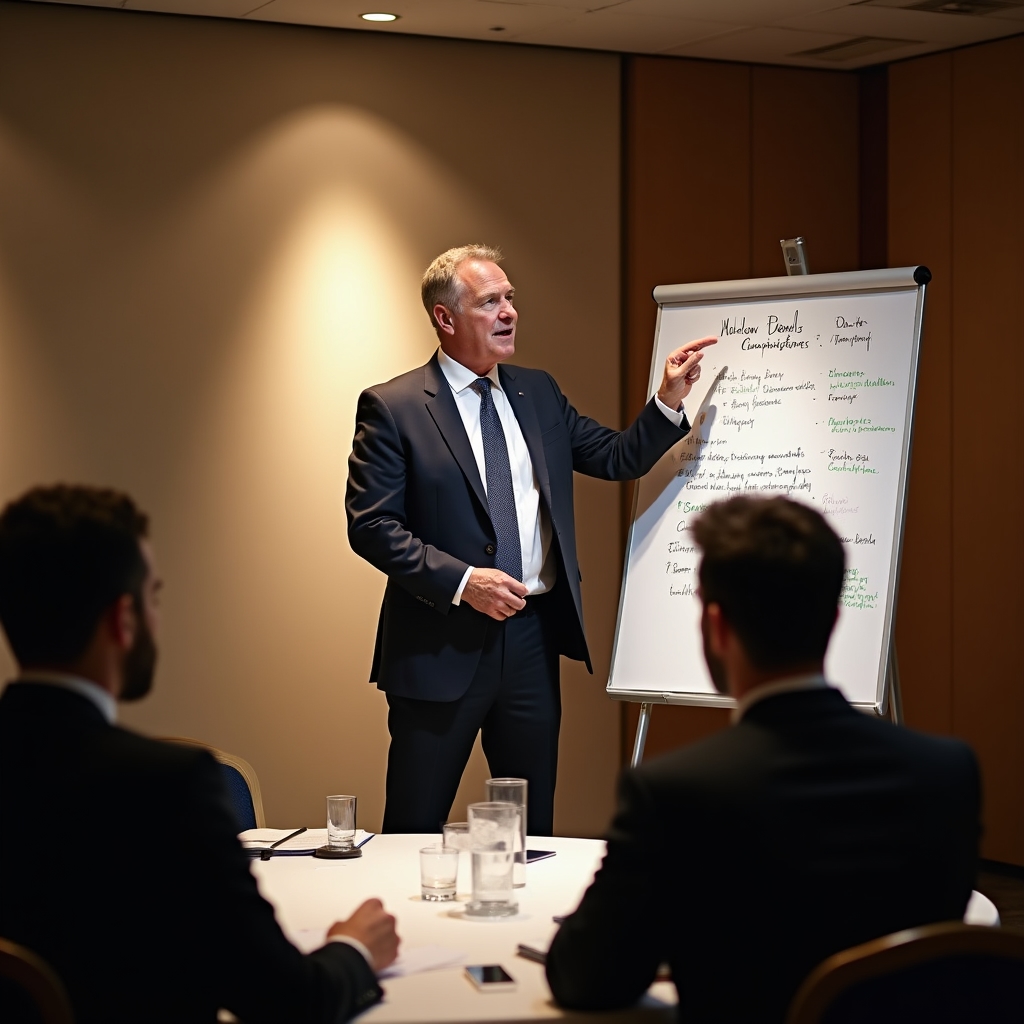
A workshop facilitator in a dark suit leading a focused small group session in a hotel conference room, warm spotlight lighting, engaged participants at a circular table
The four modules

What each session covers

Module 1

Framing Results

Foundation

Most technical professionals describe their work in terms of what they did rather than what it produced. This session focuses on learning to describe outputs in terms of organisational relevance, without distorting the technical reality.

  • The difference between describing activity and describing contribution
  • How to identify the organisational stakes your work connects to
  • Practising reframes with your own recent projects
  • Building a personal vocabulary for your contributions
Module 2

Choosing the Right Moments

Timing

Visibility is as much about when you communicate as what you say. This session maps the natural moments in organisational life where sharing progress is appropriate and expected, not self-promotional.

  • Mapping the communication moments in your current role
  • Understanding how information flows to decision-makers
  • Identifying where you are currently silent when it would be appropriate to speak
  • Creating a personal calendar of visibility moments
Module 3

Written Visibility

Written Communication

Email, status updates, documentation, and written summaries are the primary record of contribution for many professionals. This session focuses on writing that is accurate, professional, and leaves a clear picture of your involvement and impact.

  • Rewriting status updates to communicate contribution not just activity
  • How to structure project summaries for different audiences
  • Email habits that build a visible track record over time
  • The role of documentation in long-term visibility
Module 4

Conversations That Count

Verbal Communication

One-on-ones, team meetings, and performance conversations are high-stakes moments. This session develops the verbal communication skills to participate effectively in these moments without feeling uncomfortable or unnatural.

  • How to bring up your work in one-on-ones without it feeling forced
  • Responding to "how's it going?" in a way that conveys substance
  • Preparing for performance conversations with a clear narrative
  • Practising key phrases until they feel natural
Delivery formats

How the program can be delivered

Individual

One-to-one sessions with dedicated time for your specific context. The pace and depth of each session can be adjusted based on your needs. Suited to professionals with complex or sensitive work situations.

  • Four sessions of 75 minutes each
  • Flexible scheduling, four to six weeks
  • In-person in London or remote
Enquire Individually

In-Organisation

Delivered within a single organisation for a cohort of employees. Can be adapted to the specific culture, language, and dynamics of your organisation. Requires a planning conversation before delivery.

  • Adapted format to your requirements
  • Minimum cohort of six participants
  • At your location or agreed venue
Enquire for Organisations
Practical information

What to expect before and during

Before the first session

Participants complete a short written preparation covering two or three recent work situations. This means the first session can go straight into substantive work rather than spending time on introductions and context-gathering.

Between sessions

Each session includes a small applied task to complete before the next one. These are designed to take no more than 20 to 30 minutes and involve applying something directly to your current work situation.

Supporting materials

Each module comes with a concise reference document covering the key frameworks. These are designed to be useful for ongoing reference, not just during the program.

Questions between sessions

Participants can send written questions or situations between sessions. Responses are provided in writing, usually within two working days.